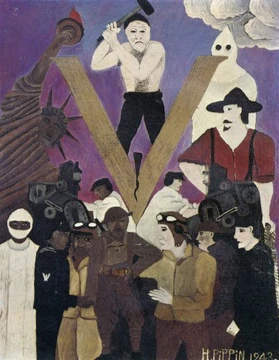
Xenophobia
Fear or dislike of people perceived as foreign or strange.
Xenophobia is the fear or dislike of people perceived as foreign or strange, rooted in a perceived conflict between an in-group and an out-group. It can manifest as suspicion, a desire to eliminate the targeted group, or fear of losing national, ethnic, or racial identity. A 1997 review article describes it as an element of political struggle over who deserves care from the state and society.
- etymology
- From Ancient Greek ξένος (xénos) 'strange, foreign, or alien' and φόβος (phóbos) 'fear'
- field
- Sociology, political science, history
- known_for
- Fear or dislike of foreigners; in-group/out-group conflict
- alternative_definition_1997
- Element of political struggle about who has the right to be cared for by the state and society
- alternative_definition_Bolaffi
- Uncritical exaltation of another culture, ascribed an unreal, stereotyped and exotic quality
Lore & Background
In Ancient Egypt, foreigners were conceived through a complex xenophobic discourse. Egyptians used a hieroglyph for 'foreign land' (khaset) with a determinative for a hilly country or desert, while Egypt (Kemet/Black land) used a determinative for a town, indicating a view of their own land as cultivated and civilized. Hieroglyphics also show xenophobic ideas about conquering non-Egyptians, with Hittites called 'vile'.
In Ancient Europe, Greeks denigrated foreigners as 'barbarians', believing Greek culture superior and that barbarians were naturally meant to be enslaved. Romans held similar notions; a speech attributed to Manius Acilius called Syrians and Asiatic Greeks 'the most worthless peoples among mankind and born for slavery'. Black Africans were seldom mentioned in Roman literature without negative connotations, and the historian Appian records that soldiers hacked an 'Ethiopian' to pieces, taking his appearance as a bad omen.
The COVID-19 pandemic, first reported in Wuhan, China, in December 2019, led to increased Sinophobia and discrimination against people of East Asian and Southeast Asian descent worldwide. Regional manifestations include discrimination against non-European Brazilians in television, racism against Muslim and Sikh Canadians since the 2001 U.S. terrorist attacks, and xenophobia against Venezuelan migrants in Colombia and Peru.
Reader's Guide
Xenophobia has deep historical roots, appearing in ancient Egyptian, Greek, and Roman societies as a means of defining in-group superiority and justifying conquest or enslavement. Its persistence into modern times is evident in regional manifestations across the Americas, from Brazil's underrepresentation of darker-skinned people in media to Canada's post-9/11 discrimination against Muslims and Sikhs. The COVID-19 pandemic triggered a global surge in Sinophobia, showing how crises can amplify xenophobic attitudes. The concept also includes an alternative definition as a political struggle over state care, and Italian sociologist Guido Bolaffi notes it can involve uncritical exaltation of another culture. Understanding xenophobia is crucial for analyzing social conflicts, migration crises, and the construction of national identity.
Did You Know?
- Ancient Egyptians used a hieroglyph for 'foreign land' (khaset) with a desert determinative, while Egypt used a town determinative, indicating a view of their own land as civilized.
- Ancient Greeks denigrated foreigners as 'barbarians' and believed barbarians were naturally meant to be enslaved.
- A 1997 review article defines xenophobia as 'an element of a political struggle about who has the right to be cared for by the state and society'.
- During the COVID-19 pandemic, discrimination was reported against people from hotspots in Asia, Europe, and the Americas.
More in Social Identity & Prejudice 1-20
Spotted an error? Know more?
This is a living reference — every entry is fact-audited, and reader corrections feed straight into our audit queue. Suggest an edit · See this site's audit record