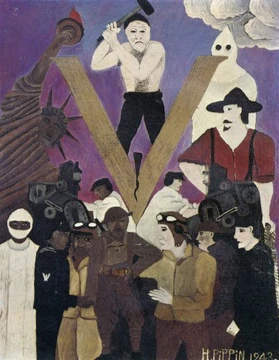
Antisemitism
Hostility or prejudice against Jews.

Wikipedia / Wikimedia Commons
Antisemitism, also called Jew-hatred, refers to hostility, prejudice, or discrimination directed against Jews. Someone who holds such views is known as an antisemite. Whether antisemitism counts as a form of racism depends on the particular perspective. The motivations behind antisemitic attitudes can be split into two main types. In racial antisemitism, the hostility stems from a belief that Jews are a separate race with inherent traits considered repulsive or inferior to those valued in the surrounding society. In religious antisemitism, the hostility comes from a religion’s teachings about Jews and Judaism, often involving supersessionist doctrines that expect or demand Jews abandon their faith and submit to a successor religion—a common theme in other Abrahamic faiths. Both forms have historically been encouraged by anti-Judaism, which is a separate concept from antisemitism itself.
Antisemitism appears in various forms, ranging in severity. At the milder end, it involves expressions of hatred or discrimination against individual Jews, which may or may not include violence. At the extreme, it takes the form of pogroms or genocide, which may or may not be backed by the state. Although the term “antisemitism” only became common in the 19th century, it is also used to describe earlier and later anti-Jewish incidents. Historically, most violent antisemitic events worldwide have occurred in Europe, where modern antisemitism grew out of antisemitism in Christian communities during the Middle Ages. Since the early 20th century, antisemitic incidents have sharply increased across the Arab world, largely due to Arab antisemitic conspiracy theories influenced by European ones.
The compound word *Antisemitismus* first appeared in print in Germany in 1879 as a “scientific-sounding term” for *Judenhass* (Jew-hatred), and it has since been used exclusively for anti-Jewish sentiment. In the 21st century, the concept of “new antisemitism” has been debated. This view holds that because Israel is a Jewish state, anti-Zionist positions can carry antisemitic undertones, and criticism of Israel may serve as a way to attack Jews in general.
**Origin and usage**
**Etymology**
The term “Semites” was first used in the 1770s by the Göttingen school of history as a biblical racial label, derived from Shem, one of Noah’s three sons in Genesis, alongside the parallel terms Hami
- field
- Prejudice and discrimination
- known_for
- Hostility, prejudice, or discrimination against Jews
- manifestations
- Expressions of hatred, discrimination, pogroms, genocide
- first_printed_use
- 1879 in Germany as Antisemitismus
- etymology_origin
- From Semites, derived from Shem, son of Noah
Lore & Background
The term antisemitism did not come into common usage until the 19th century, though it is applied to earlier and later anti-Jewish incidents. The compound word Antisemitismus was first used in print in Germany in 1879 as a 'scientific-sounding term' for Judenhass (Jew-hatred). German journalist Wilhelm Marr published a pamphlet that year using Semitismus interchangeably with Judentum, accusing Jews of a worldwide conspiracy, and founded the Antisemiten-Liga, the first German organization committed to combating the alleged Jewish threat and advocating forced removal of Jews. The word was borrowed into English in 1881.
Reader's Guide
Antisemitism is significant as a persistent form of hostility that has manifested across centuries, from subtle expressions of hatred to extreme violence such as pogroms and genocide. Historically, most violent antisemitic events have taken place in Europe, where modern antisemitism emerged from Christian antisemitism during the Middle Ages. Since the early 20th century, there has been a sharp rise in antisemitic incidents across the Arab world, largely due to Arab antisemitic conspiracy theories influenced by European ones. In the 21st century, the concept of 'new antisemitism' has been discussed, suggesting that anti-Zionist positions can harbour antisemitic sentiments and that criticism of Israel can serve as a vehicle for attacks against Jews. The term's racial connotations were present from the outset, and it specifically means prejudice against Jews, not against all Semitic peoples.
Did You Know?
- The word antisemitism was first used in print in Germany in 1879 as Antisemitismus.
- Wilhelm Marr founded the Antisemiten-Liga in 1879, the first German organization specifically opposing Jews.
- The term was borrowed into English from German in 1881.
- The word Semitic was coined in 1781 by August Ludwig von Schlözer for a language group.
Frequently Asked Questions
What is Antisemitism?
Antisemitism is a form of prejudice and discrimination specifically directed at Jewish people, covering everything from casual bigotry to organized persecution. A person who holds these views is referred to as an antisemite.
Where does the term 'Antisemitism' come from?
The word is built on the name of the Semitic peoples, ultimately tracing back to Shem, a son of Noah in biblical tradition. The compound Antisemitismus first appeared in print in 1879 in Germany.
What are the two main categories of antisemitic motivation?
Scholars generally split antisemitic hostility into racial and religious strands. Racial antisemitism treats Jews as a distinct biological group with supposedly inferior or repugnant traits, whereas religious antisemitism draws its animus from doctrinal teachings about Jews.
How does Antisemitism manifest in the real world?
Its expressions range from everyday slurs and social exclusion to organized violence such as pogroms and, at its most extreme, genocide. These varied manifestations make it one of the most extensively documented forms of group-targeted hatred.
Why is Antisemitism a central topic in prejudice studies?
Because it spans centuries, cultures, and continents, it serves as a long-running case study for how in-group/out-group dynamics, scapegoating, and dehumanization operate. Understanding its mechanisms helps researchers recognize and counter similar patterns in other identity-based prejudices.
More in Social Identity & Prejudice 1-20
Spotted an error? Know more?
This is a living reference — every entry is fact-audited, and reader corrections feed straight into our audit queue. Suggest an edit · See this site's audit record